facebook

deepfakes by Richard

Misinformation on the internet is an everyone problem. To combat it, publishers, social media and people need to find new ways of working together.

In a time of heightened political polarization and widespread social media use, the prevalence of misinformation online is a persistent problem, with increasingly serious effects on elections and the stability of governments around the world. I will put my Facebook account and most of my my social networks on hold. Moving the conversation to a safer platform such as “signal” for the moment, and being selective to what news to event, to read or look at.

There is a gap between the information news organizations possess and the subset of that information to which their users have access. That’s especially true when that media travels around the internet, largely stripped of its original context.

Especially on Facebook, where trolls and bad actors have established many tools for misleading people, generally using authentic photos and videos as source material. Some of the techniques are simple: recycling old images, selective cropping and editing, slowing down and speeding up videos, and so on. Other techniques are more sophisticated, involving the creation of “synthetic” media such as deepfakes.

Regardless of the complexity of these actions, they contribute to misinformation, extremist propaganda and undemocratic governmental changes, but in being designed to go viral, many people unwittingly spread it within their own Facebook networks.

If you believe in democracy one should see The Great Hack. It is about the Trump campaign, the Leave.EU campaign and many other reckless electoral adventures all over the world and their connection with Cambridge Analytica, the British data research company that cunningly harvested information from millions of Facebook users and their friends via an innocuous-seeming “personality” questionnaire.
I'd like to add you... of course you want by Richard

If you send me an invitation to connect on LinkedIn and you don't take the time to personalize it, then why should I take the time to consider it?

For me, I usually limit my LinkedIn connections to people I've met or worked with in some capacity. It's my professional social network, facebook is my private and more loose social network.

So when I get an invitation from someone I may have met at a conference, or who knows me from reading this site, I like to have a clear answer why they'd like to connect or where we meet, I then reply :

Hey Joe,

Thanks for the request, please remind me how we meet. I am sorry if I don’t remember :)

Looking forward,

Richard


If don't receive a proper answer, then I delete the request.

sn2.jpg

Facebook is turning facial recognition back on! by Richard

Facebook turns off Facial Recognition in the EU, waiting for the all-clear from Ireland’s Data Protection Commissioner. But turns it on in rest of the world!

At the end of 2010, Facebook announced that it would be using facial recognition to make it easier for you to tag other people in your photos. Last year, Facebook temporarily suspended the feature "to make some technical improvements,". But now it's back. Here's a visual summary of how to manage photo tagging on your Facebook account, depending on what account you have.

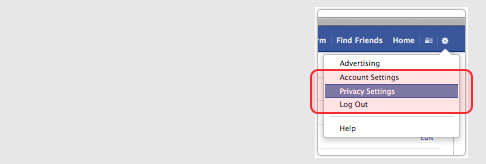
You start by clicking on the gear icon at the far right, and choosing Privacy Settings from the menu:

1.png

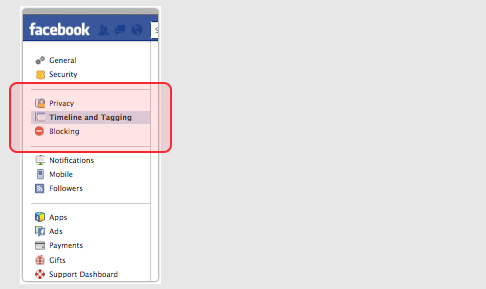
Then go to the menu at the far left, and choose Timeline and Tagging:

2.png

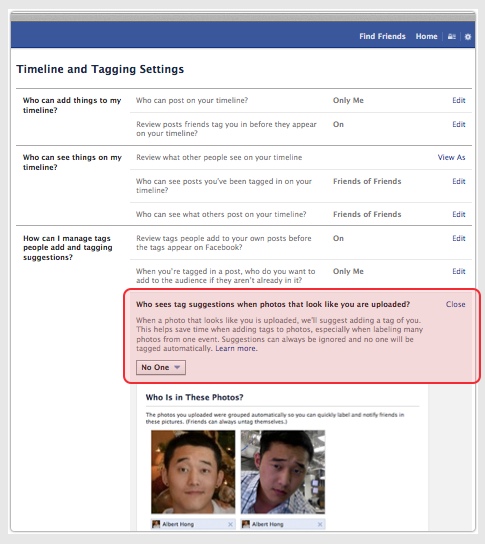
And now review your settings, including the all-important Who sees tag suggestions when photos that look like you are uploaded, set it to No One:

3.png

we become subscription junkies by Richard

Netflix, Dropbox, Spotify, Gmail, Skype, Cable TV, WOW and at the office we are virtual also. We just rent the service we need; Salesforce, Soonr, Amazon, Google, e-conomic, even the office space is a virtual office and please don’t forget the daily fruit basket subscription. 

Hey, why not using outsourced personnel as your workforce, so now you have a virtual office, with virtual employees, talking via a virtual telephone switch, saving all the documents in the cloud…

A survey at the University of Chicago, Northwestern, Berkeley, Columbia, and the University of Pennsylvania. Respondents estimated spending $18.65 per month on current subscription services, such as Amazon Prime, Dropbox Pro, Spotify, etc., but noted a willingness to spend over $45 monthly long-term.

One day, Mark Zuckerberg will ask us for $ 1 per month. Suddenly, Facebook Inc., will receive a revenue of half a billion to one billion dollars every month, or maybe even more...

Today you can’t login or create an account at some services, if you don’t have a facebook account. I don’t like to be forced into a subscription, that’s a little bit too much.​

Understand me right, I like today’s possibilities and tools, but we need to sit back and reflect on the consequences of such openness and freedom. We need to pick the right subscriptions and manage them properly!

I have a life outside Facebook also, but unfortunately I forgotten my password and my subscription was cancelled :)

The Hon. Carl Bildt, Minister for Foreign Affairs, Sweden Mr. Nick Coleman, Global Head of Cyber Security Intelligence, IBM H.E. Toomas Ilves, President, Republic of Estonia Moderator: Mr. Nik Gowing, BBC World